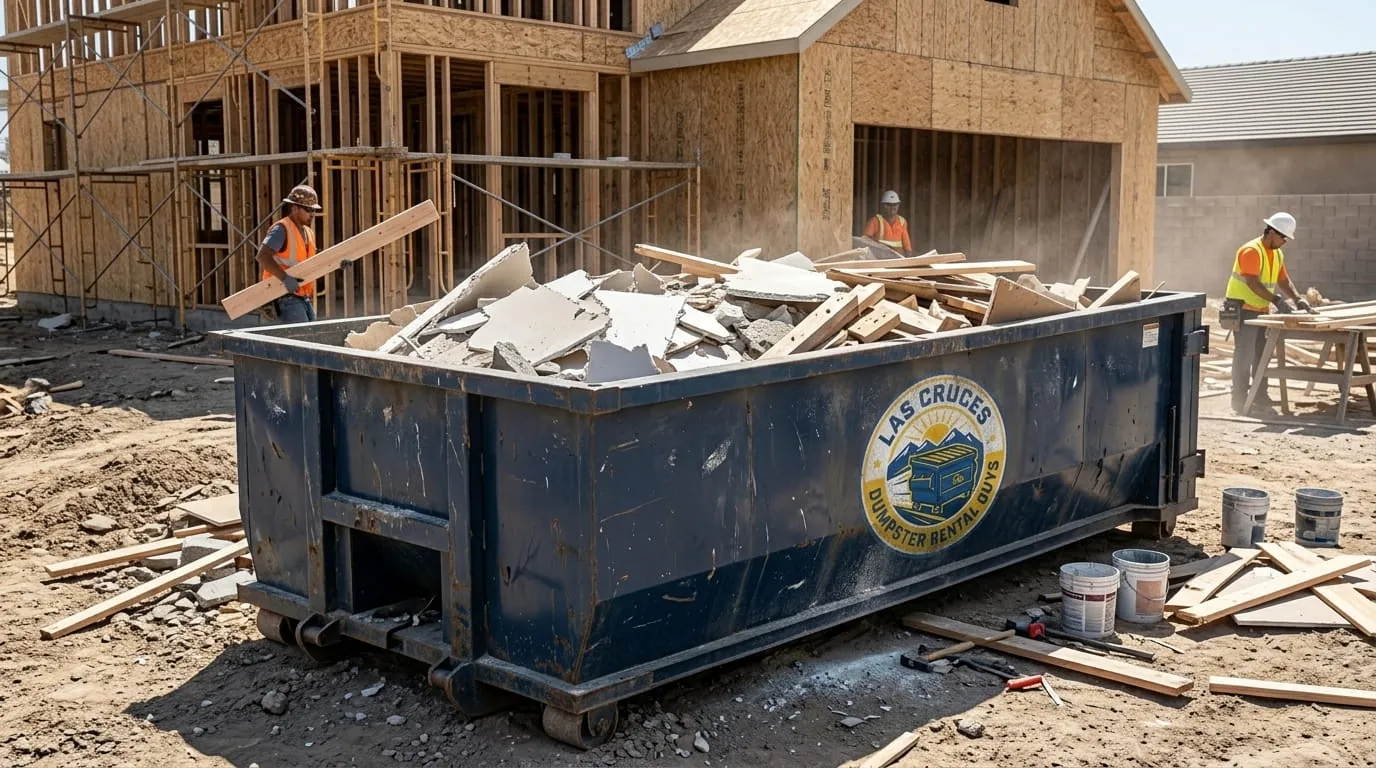
Every summer we get the same call. A homeowner off Sonoma Ranch or a contractor working a flip near Mesilla stripped their roof over the weekend, rented a big 30-yard box because bigger felt safer, and now it is sitting a quarter full and the driver says it is over the weight limit. Roofing is the one job where the dumpster that looks too small is almost always the right one. Shingles fool people. They are thin, they stack flat, and they are deceptively, punishingly heavy.
I have been dropping roll-offs across Las Cruces and Doña Ana County long enough to have a rule of thumb for almost every roof in the valley. This is the breakdown I wish more folks had before they picked up the phone: how much a tear-off actually weighs, why the desert throws in a few wrinkles, and why the 10 to 15 yard range wins on the overwhelming majority of residential jobs here.
Why roofing debris is heavier than almost anything else you'll throw away
Think about what a shingle is. Asphalt saturated felt or fiberglass mat, packed with mineral granules and coated in more asphalt. It is basically a thin sheet of rock and tar. A single three-tab shingle does not weigh much, but a roof has thousands of them, plus the felt paper, the drip edge, the old flashing, and whatever the last three roofers left up there.
The unit that matters is the square. In roofing, one square equals 100 square feet of roof surface. Shingles are sold and installed by the square, and that is how every estimate you get will be worded. A typical single-story Las Cruces house with a simple hip or gable roof runs somewhere between 15 and 25 squares once you account for overhang and pitch.
Here is where the weight sneaks up on you. A square of standard three-tab asphalt shingles weighs roughly 230 to 250 pounds. Architectural or dimensional shingles, the thicker laminated kind that most newer homes here wear, run heavier, closer to 300 to 400 pounds per square. And that is just the shingles. Add the felt underlayment, the tear-off debris, nails, and the odd rotten board, and your real disposal weight climbs another 10 to 20 percent.
The shingle math, done simply
Let's run a real example. Say you have a 20-square roof with a single layer of architectural shingles.
- 20 squares × 350 lbs per square = 7,000 lbs of shingles
- Add roughly 15 percent for felt, flashing, and misc debris: about 1,050 lbs
- Total tear-off weight: right around 8,000 lbs, or 4 tons
Four tons. From one average roof. Now you understand why the guy with the 30-yard box gets a surprise. That container could physically hold three or four roofs by volume, but the truck can only legally and safely haul so much weight. Overloaded roll-offs are dangerous to lift, illegal to transport on New Mexico roads, and they tear up your driveway on the way out.
A quick field formula you can use on your own roof: take your total squares, multiply by 250 for three-tab or 350 for architectural, then add 15 percent. Divide by 2,000 to get tons. Keep that number in your head when you size a container. Most disposal is priced with a tonnage allowance built in, and roofing is the one job where you can blow past that allowance with a half-empty box.
Single layer versus multi-layer tear-offs
This is the single biggest variable, and it is the question I ask first on every roofing call. How many layers are coming off?
Building codes let you stack a second layer of shingles over the first in a lot of cases, so plenty of older Las Cruces homes are carrying two full layers, and I have pulled three off houses in the older parts of town and out in the county. Every layer doubles the weight math above.
- One layer, 20 squares: about 4 tons. A 10 or 15 yard box handles it comfortably.
- Two layers, 20 squares: about 8 tons. Now you are into a 15-yard with a firm weight cap, or you split it across a swap.
- Three layers: you are hauling serious tonnage and should plan on multiple pulls no matter the box size.
If you do not know how many layers you have, walk the edge of the roof and look at the shingle exposure at a cut or a valley, or count layers at the rake edge. When in doubt, tell whoever you rent from that you are unsure. A good operator would rather size you up front than send a truck that cannot lift the load.
Flat, low-slope, and foam roofs: the desert Southwest wrinkle
Not every roof in Doña Ana County is asphalt shingle. Drive through Mesilla, the historic parts of Las Cruces, or any adobe-style build and you see a lot of flat and low-slope roofs, and the debris coming off them is a different animal.
Built-up roofs, the old tar-and-gravel systems, are brutally heavy because of the gravel ballast and layered bitumen. A tear-off of built-up roofing can weigh more per square than shingles by a wide margin, and the gravel alone can max out a container fast. If you are pulling a gravel roof, size down on volume and plan for weight, not space.
Foam roofs, the sprayed polyurethane systems you see all over the desert Southwest, are the opposite. The foam itself is light and bulky, so a foam recoat or tear-off fills a box by volume long before it hits any weight limit. If your job is mostly foam and old coating, you may actually want more cubic yards, not fewer. And tile roofs, less common here than in Phoenix or Tucson but still around, behave like concrete debris: extremely heavy, and best kept to a low-fill line in a small container.
The takeaway is that the material dictates the strategy. Asphalt and tile are weight problems. Foam is a volume problem. Tell your hauler what is actually up there and the sizing gets easy.
Why 10 to 15 yards is the roofing sweet spot
For the overwhelming majority of residential asphalt tear-offs in Las Cruces, a 10 or 15 yard roll-off is the right tool, and it is not close.
A 10-yard box is compact, sits neatly on a single-car driveway, and paired with a proper weight allowance it swallows a small single-layer roof without trouble. The 15-yard is the workhorse. It gives you the extra volume for a larger roof or a two-layer tear-off while keeping the footprint driveway-friendly and the weight within what a truck can safely pull off residential streets. If you want the specs and capacity side by side, our 15-yard dumpster page lays out dimensions and typical loads.
Those bigger 20 and 30 yard containers earn their keep on framing debris, whole-home cleanouts, and light bulky junk, the stuff that fills space without loading down the axle. Put roofing shingles in them and you will hit the weight ceiling with the box a third full, paying to haul air you never used. The small box is not a compromise on a roof. It is the correct engineering answer.
Not sure which size fits your roof? Tell us your squares and how many layers, and we'll size it right the first time. Call Las Cruces Dumpster Rental Guys at (575) 449-8691 for a straight answer and same-day or next-day drop-off across Doña Ana County.
Driveway placement: what roofers actually need
Placement makes or breaks a tear-off. A roofing crew is throwing debris off the roof all day, and every extra foot they have to carry a shovelful of shingles is time and money. Here is what works.
- Get the box tight to the house, under the tear-off zone. The ideal spot is directly below the largest roof plane so the crew can rake and toss straight into the container. A box parked at the curb 40 feet away turns into a wheelbarrow relay.
- Protect the driveway. We set boards or plywood under the wheels and the load points on request. Our containers roll on and off, and a fully loaded roofing box is heavy enough to mark soft asphalt on a hot Las Cruces afternoon when the surface is baking. A few boards prevent that.
- Mind the clearance. The delivery truck needs overhead room, no low branches or power lines over the drop spot, and a straight shot to back in. Gravel and dirt driveways out in the county are usually fine, but let us know so we can plan for it.
- Leave the tarp lane clear. Good roofers tarp the ground and toss to a staging pile, then load the box. Give them room on one side of the container to work.
If the driveway genuinely will not work, a street placement may need a permit depending on where you are in the city or county. We can walk you through that. Roofing debris is exactly the service we plan these details around, and you can see the full scope on our roofing dumpster rental page.
Scheduling swaps on the bigger jobs
On a two or three layer tear-off, a big cut-up roof, or a full commercial low-slope job, one container will not do it, and that is fine. The move is a swap, sometimes called a dump-and-return: we haul the full box to the transfer station, empty it, and bring it right back, or drop a fresh one so the crew never stops.
A few things that make swaps go smoothly:
- Book the swap before you need it. If you know it is a two-layer roof, tell us at the start so we can slot the return into the schedule. A crew standing around waiting on an empty box is the most expensive kind of idle.
- Time it to the tear-off pace. Most crews strip in the morning when it is cool and dry-in by afternoon. A mid-day swap keeps them moving without a hot-afternoon bottleneck.
- Keep loads level and under the fill line. An evenly loaded box swaps faster and legally. Mounded shingles over the rail cannot go on the road and slow everyone down.
Two 15-yard pulls almost always beat one oversized box on a heavy roof. You stay under weight limits on each haul, the crew keeps a workable footprint on the driveway, and you only pay for what you actually throw away.
The short version
Roofing is a weight game, not a volume game. Figure your squares, multiply by 250 or 350 depending on shingle type, add 15 percent, and know your layer count before you rent. For most Las Cruces homes that lands you on a 10 or 15 yard box with a real weight allowance, placed tight to the house on a protected driveway, with a swap on standby for the heavy multi-layer jobs. Get those pieces right and the dumpster is the easiest part of the whole project.
When you are ready, we're local, we answer the phone, and we can usually get a box to you same day or next. Reach out through our contact page or call and we'll get your roof handled.

Founder, Las Cruces Dumpster Rental Guys — sharing straight advice from more than 15 years of local hauling experience.