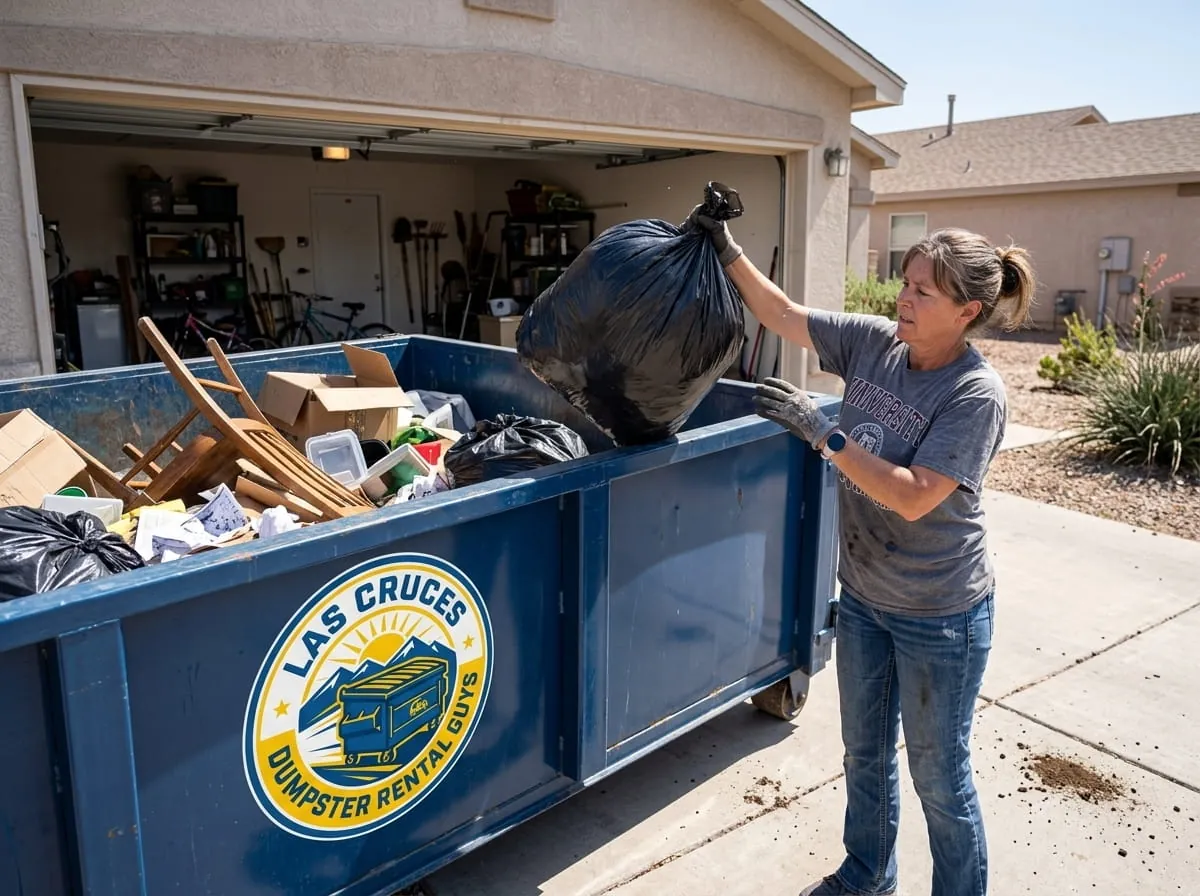
Nine times out of ten, the answer is no. If you're putting a roll-off in your own driveway for a garage cleanout or a kitchen remodel, you don't need anybody's permission but your own. But the question comes up constantly, and for good reason. Get it wrong on a public street and you're looking at a stop-work order, a fine, or a very awkward call from a code officer while your contractor stands around on the clock.
I've been dropping containers around Las Cruces and Doña Ana County long enough to know where the real lines are. This walks through when a permit matters, when it doesn't, and what actually happens if you have to pull one. None of this replaces a call to the City or the County, and I'll say that more than once, because rules change and every property is a little different.
The Short Version: Private Property vs. Public Right-of-Way
Here's the rule of thumb that covers most jobs. If the dumpster sits entirely on land you own or control, you generally don't need a municipal permit. If any part of it touches the public right-of-way, you probably do.
That's the whole game, really. The tricky part is knowing where your property actually ends and the public right-of-way begins, because it's almost never where people think it is.
On your private driveway or lot
Drop it on your driveway, your parking pad, a side yard with room, or a private commercial lot, and you're clear of the permit question in almost every case. No city paperwork. You still want to be smart about placement, which I'll get into, but there's no permit to pull.
This is why we push driveway placement whenever it's possible. It's faster, it's free, and nobody from the City ever has to be involved. If you've got the room, use it.
On a public street, curb, or alley
The moment a container occupies the paved street, the curb lane, a public alley, or the strip between the sidewalk and the road, you're on the public right-of-way. That's shared public space, and the City of Las Cruces controls what sits on it and for how long. This is where a permit typically comes in — often called a right-of-way, encroachment, or obstruction permit depending on who you talk to and how the request is written up.
The reason is simple. A big steel box in the travel lane changes how traffic moves, how emergency vehicles get through, and how water drains along the gutter. The City has a legitimate interest in knowing it's there.
The Part Everyone Misses: Your Property Line Isn't the Curb
This trips up more homeowners than anything else. People assume their yard runs to the edge of the pavement. It usually doesn't. In a lot of Las Cruces neighborhoods, the public right-of-way extends several feet past the curb, back toward your house — sometimes it includes the sidewalk and a chunk of what looks like your front lawn.
So you could set a container on grass you mow every week and still technically be in the right-of-way. That's not me trying to scare you into buying a permit. It's just how platting works, and it's worth knowing before you assume you're covered. If a placement is anywhere near the street, treat it as a maybe until you've confirmed the actual line.
How Municipal Permits Generally Work in New Mexico
Permit processes vary by jurisdiction across New Mexico, but the shape of it is fairly consistent. Here's what you can generally expect if a street placement means you need one.
- Where it's handled: Right-of-way and encroachment permits usually run through the City's public works, engineering, or a related permitting office. For addresses in unincorporated Doña Ana County — outside city limits — you're dealing with the County instead, and their process is separate.
- What they want to know: The address, where exactly the container goes, roughly how big it is, and how long it'll stay. Some jurisdictions ask for a simple sketch of the placement.
- Timeframe: Permits are usually tied to a window of days. Longer projects may need an extension or a renewal, so build that into your planning.
- Fees: There's typically a fee, and it varies. I won't quote you a number, because it changes and I'd rather you hear the real figure from the source than an outdated one from me.
- Conditions: The permit may spell out marking or reflective requirements, distance from intersections and hydrants, and drainage rules. Follow them. They're the difference between a permit that holds up and one that gets pulled.
To confirm any of this for your specific address, contact the City of Las Cruces directly, or Doña Ana County if you're outside city limits. That's the only way to get current, accurate answers on process and cost.
Doña Ana County vs. City of Las Cruces
This matters more than folks expect. A Las Cruces mailing address does not automatically mean you're inside the city. Plenty of homes around Mesilla, in the county pockets, and out toward the edges carry a Las Cruces zip but sit in unincorporated Doña Ana County — and the County runs its own rules and its own permitting.
Before you assume which agency to call, find out whether your parcel is inside city limits or in the county. If you're not sure, we can usually tell you based on the address when you book, and we serve both — you can see our full coverage across the areas we cover.
HOA Rules Are a Whole Separate Layer
Here's something a City permit won't help you with at all. If you live in an HOA, that's a private set of rules running on top of everything else, and HOAs care a lot about big containers.
Common HOA restrictions I run into:
- Limits on how many days a dumpster can sit visible from the street
- Requirements to keep it on the driveway and off any common area
- Advance notice to the board or a quick approval before it arrives
- Screening or placement rules meant to keep it tidy
An HOA can ding you even when the City has zero issue with your placement. If you're in a managed community, check your CC&Rs or shoot the board a quick message before the container shows up. Two minutes now saves you a violation letter later.
Placement Rules That Keep You Out of Trouble
Permit or not, where the box goes matters. These are the habits that keep a delivery clean.
- Keep sightlines clear at corners and driveways. Don't block a driver's view of oncoming traffic or pedestrians.
- Stay clear of fire hydrants, water valves, and utility access. Blocking a hydrant is a fast way to a fine, and it's genuinely dangerous.
- Don't obstruct drainage. In our climate the rain comes hard and quick. A container parked over a gutter line during monsoon season causes real problems.
- Protect the surface. Roll-offs are heavy, and loaded ones are heavier. On a nice driveway we put down boards under the rails to spread the weight and protect the concrete or asphalt.
- Leave room to load. The doors swing, and the truck needs a clean approach for drop and pickup. Cramming it into a tight spot just means a headache on both ends.
- Mind low branches and wires. These trucks lift high. Overhead clearance is easy to forget until it's a problem.
Most of this is common sense, but common sense gets lost when a project's moving fast. A minute of thought on placement pays off.
Not sure whether your spot needs a permit or just a good placement plan? Call Las Cruces Dumpster Rental Guys at (575) 449-8691 and we'll walk through your address before anything gets scheduled.
Who's Actually Responsible for the Permit?
Straight answer: responsibility usually lands on the property owner or the customer renting the container, not automatically on the rental company. When it's a permitted street placement, the permit is generally tied to the property and the person requesting the work.
That said, arrangements differ, and a good rental outfit will tell you plainly where the line sits before you book. Sort this out up front. The worst version of this conversation is the one that happens after a code officer has already left a notice on your door and everyone's pointing fingers about whose job the paperwork was.
How We Help on Our End
We're not the permitting authority, and I want to be clear about that — we can't issue a permit and we can't promise an approval. But we're not going to leave you guessing either. Here's what we actually do:
- Talk through your placement before delivery and flag whether it looks like private property or right-of-way
- Point you to the right agency — City of Las Cruces or Doña Ana County — for your specific address
- Size the container to your job so you're not permitting more street than you need
- Coordinate delivery and pickup timing around your permit window so it doesn't sit out longer than allowed
- Place it carefully and protect your driveway surface on private drops
The goal is a drop that goes smooth and a haul-off that's on time, with no surprise notices in between. If you want to see the container sizes and how our roll-off dumpster rental works, that page lays it out.
Bottom Line
Private driveway, private lot — no permit, just smart placement. Public street, curb, or alley — expect a permit, and remember the right-of-way often reaches farther onto your lot than you'd guess. HOA rules ride on top of all of it, and it pays to confirm which agency governs your parcel, city or county.
When in doubt, confirm with the City of Las Cruces or Doña Ana County for your exact address, and give us a call so we can help you plan the placement. Ready to book or just have questions? Reach out to us and we'll get you sorted.
Founder, Las Cruces Dumpster Rental Guys — sharing straight advice from more than 15 years of local hauling experience.