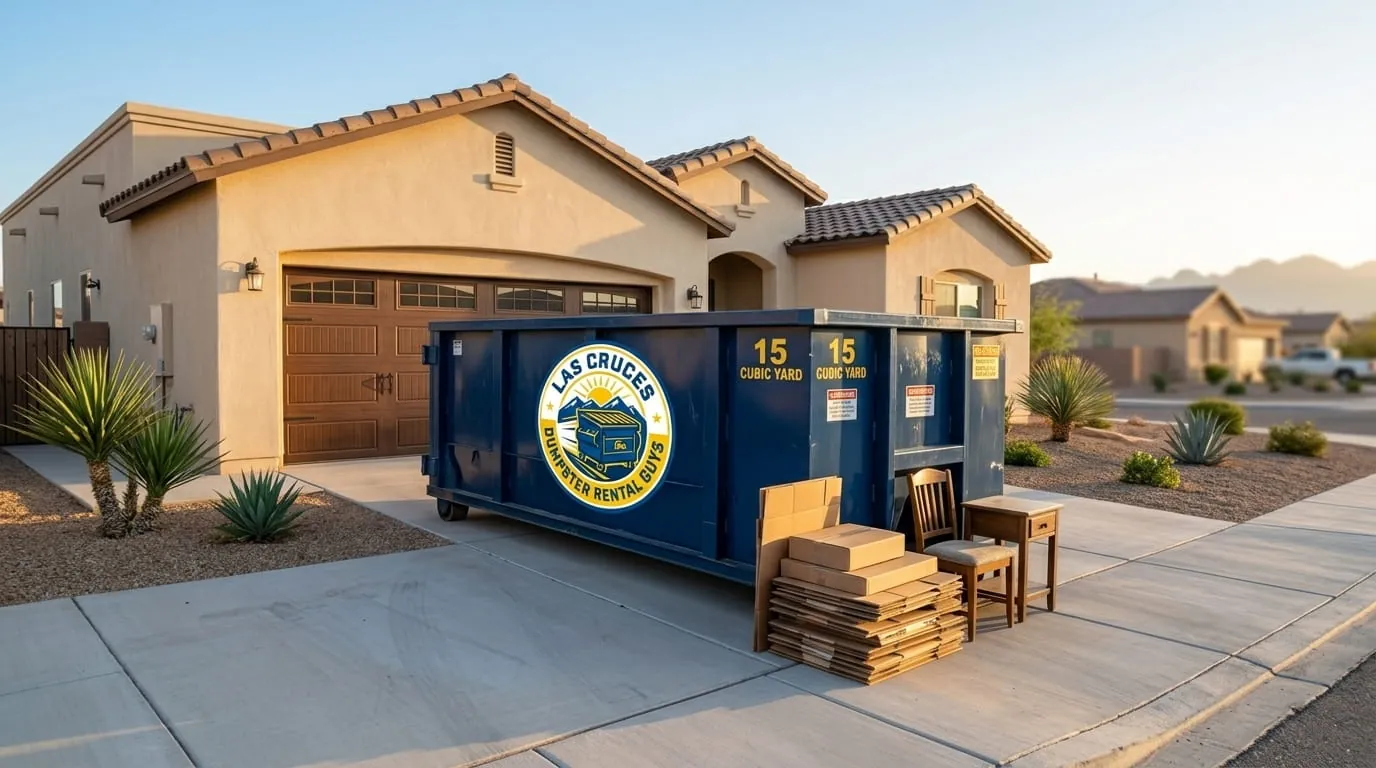
I've set roll-off dumpsters on driveways all over Las Cruces for years, from brand-new stamped concrete out in Sonoma Ranch to cracked old asphalt aprons off Solano. And I'll tell you what most rental companies won't: the container isn't the thing that damages your driveway. Careless placement, the wrong surface on the wrong day, and a driver in a hurry are what leave you with a repair bill. The good news is that driveway damage is almost entirely preventable, and once you understand why it happens, you can protect your property with about twenty dollars of lumber and ten minutes of planning.
Why a Roll-Off Can Actually Crack Your Driveway
People underestimate what these bins weigh. An empty 20-yard roll-off runs somewhere between 4,000 and 6,000 pounds of steel before you throw a single thing in it. Load it with roofing shingles, broken concrete, or wet drywall and you can easily push the loaded weight past 10,000 pounds. Now here's the part that matters: that weight isn't spread out evenly like a car sitting on four tires.
A roll-off rides on two small rear wheels and rests on a front lip or a rail. When the truck rolls it off the bed, all that mass concentrates on a handful of tiny contact points. The rear wheels press down through an area not much bigger than your two hands. The front rails or the tongue can dig in like a chisel. That's what engineers call point loading, and point loading is what cracks a slab. It isn't the total tonnage so much as the tonnage divided by the square inches carrying it.
Two other moments do most of the harm. The first is delivery, when the bin drags and rolls into position and the wheels bite. The second is pickup, when the truck's cable winches a fully loaded container back up the tilted bed and every pound drags across your surface at once. If your driveway is going to get hurt, it usually happens in those two windows.
The Las Cruces Heat Factor Nobody Warns You About
This is where our part of the world is different from a lot of the advice you'll read online. In July and August, our asphalt surface temperatures can climb well past 140 degrees in the afternoon sun. Asphalt is a petroleum product. When it gets that hot, it softens. It goes from rigid to almost pliable, and a heavy point load will press right into it and leave a permanent dent or rut, the same way a high heel sinks into hot blacktop at a summer fair.
I've seen a bin sit on a soft afternoon driveway for a week in August and leave two wheel divots you could rest a golf ball in. The same container on the same driveway in November would have done nothing. So timing genuinely matters here. If we can, we deliver to asphalt in the morning when the surface is still cool and firm. And we never skip the boards on a hot day, because the heat turns a manageable load into a guaranteed impression.
Concrete doesn't soften the way asphalt does, but our desert climate works on it too. Big daily swings between a 100-degree afternoon and a cool night stress concrete through expansion and contraction, and older slabs out here often already have hairline cracks and control joints that are weaker than they look. A concentrated load parked right on an existing crack can widen it fast.
Boards and Plywood: The Twenty-Dollar Insurance Policy
The single most effective thing you can do is put wood between the container and your driveway. The whole idea is to take those tiny point loads and spread them across a much bigger footprint, so the pressure per square inch drops to something your surface can shrug off.
Here's how I do it, and how I tell customers to do it if they want to lay the wood themselves before we arrive:
- Under the rear wheels: use thick lumber, not thin scraps. Two-by-tens or two-by-twelves work well, or a doubled-up sheet of three-quarter-inch plywood. Lay them flat and wide so each wheel rolls onto solid wood, not off the edge of it.
- Under the front rails or tongue: this is the spot people forget, and it's often the sharpest point load on the whole bin. A couple of stacked boards or a section of thick plywood under the front lip keeps that steel edge from biting into the slab.
- Length matters: the boards need to be long enough that the wheels stay on them through delivery and pickup, not just while parked. The container shifts a little when it's winched, so give yourself margin.
- Use new or sound wood: a rotten, split board just cracks and does nothing. Cheap fresh lumber from any Las Cruces yard is a few dollars a board and pays for itself many times over.
Plywood alone, a single sheet, is better than nothing but it flexes. For a heavy load I like dimensional lumber under the wheels and plywood as a spreader on top, or doubled plywood. The goal is a stiff platform that distributes the weight rather than a thin sheet that just telegraphs the point load straight through.
Gravel and Caliche Driveways Around the County
A lot of properties out in the county, past the city limits toward Mesilla, Doña Ana, Radium Springs and the rural stretches, sit on gravel or caliche rather than paved surfaces. These bring their own considerations.
Caliche, that hard calcium-carbonate hardpan we all know out here, is actually a decent bearing surface when it's dry and compacted. It can take a roll-off better than you'd think. The problem is water. If we've had a monsoon storm and the caliche or gravel is saturated, the wheels can sink, rut the drive, and leave the container tilted, which makes pickup miserable and can shift the load. On soft or wet ground I always want boards or even a sheet of steel under the wheels to keep the bin from settling.
Loose gravel has the opposite failure mode: the wheels push the rock around and you end up with ruts and displaced gravel that has to be raked back. It's not damage in the expensive sense, but it's a mess. A few boards keep the gravel where it belongs and keep the bin level.
Placement Alternatives That Skip the Problem Entirely
Sometimes the smartest move is to not put the dumpster on the driveway at all. Depending on your property and your project, you have options:
- The street: in much of Las Cruces you can place a roll-off at the curb, sometimes with a permit from the city for right-of-way use. This keeps all that weight off your private surfaces entirely. If you're unsure whether your street allows it, ask us and we'll walk you through it.
- A gravel or dirt side yard: if you've got a spot off the driveway that can take the weight, it's often the lowest-risk choice.
- The apron versus the slab: the thick concrete near the street is usually stronger than a thin decorative slab up by the garage. Sometimes just moving the bin ten feet puts it on sturdier ground.
For most homeowners doing a garage cleanout or a small remodel, our residential dumpster rental options are sized so you're not putting an oversized container on a small driveway in the first place. Right-sizing the bin is itself a form of driveway protection: a 10 or 15-yarder concentrates far less weight than a 30-yard box you didn't need.
Worried about your driveway? Talk it through before you book. We'll help you pick the right size, the right spot, and the right protection for your surface and the season. Call Las Cruces Dumpster Rental Guys at (575) 449-8691 and we'll give you straight answers.
What a Good Hauler Does Without Being Asked
You shouldn't have to be a driveway expert to avoid damage. A professional company handles most of this for you. Here's what separates a careful operation from a company that just wants to drop and go:
- They ask about your surface. Before delivery, a good dispatcher asks whether you're on asphalt, concrete, gravel or caliche, and how old it is. That one question changes how we set the bin.
- They carry and place boards. We bring our own lumber and lay it under the wheels and front rails as standard practice, not as an upsell.
- They mind the heat. On brutal summer days a good local driver will schedule asphalt deliveries early and go slow on placement.
- They set it level and straight. A bin that's placed square, with the door facing where you need it, doesn't get dragged and repositioned, and every reposition is another chance to scar the surface.
- They control the pickup. Winching a loaded container is the highest-risk moment. An experienced driver eases it up the bed instead of yanking it, and keeps the boards in place until the wheels are clear.
Any company running roll-off dumpster rentals in this valley should be doing all of that as a matter of course. If a hauler shrugs when you ask how they'll protect your driveway, that tells you something.
HOA Neighborhoods and Keeping the Peace
Plenty of Las Cruces subdivisions, especially the newer ones on the east mesa and up around the foothills, have HOAs with rules about dumpsters. Some limit how long a container can sit, some require it on the driveway rather than the street, and some want it screened or placed out of sight. Protecting your driveway and staying on the association's good side often go hand in hand.
A few things that keep the peace: keep the bin on your own property if the HOA requires it, which makes the boards-and-placement conversation even more important. Keep it tidy and don't overfill it, since an overflowing bin is what triggers neighbor complaints. And get the timeline right, because a container that lingers past the allowed window is both an HOA violation and, on hot asphalt, more time for the wheels to settle in. Book your rental so the bin arrives when you're ready to fill it and leaves promptly when you're done.
A Quick Pre-Delivery Checklist
- Decide your spot: strongest surface, level, clear of low branches and gates.
- Have boards ready, or confirm the company brings them.
- On asphalt in summer, ask for a morning delivery.
- Clear cars and toys so the driver isn't threading a needle.
- Check your HOA rules on placement and duration before you book.
- Tell the company your surface type when you order.
None of this is complicated, and none of it costs much. A little wood, a little timing, and a hauler who actually cares about your property will keep your driveway looking exactly the way it did before the dumpster showed up. If you want a hand figuring out the right setup for your home, get in touch and we'll sort it out with you before anything rolls off the truck.

Founder, Las Cruces Dumpster Rental Guys — sharing straight advice from more than 15 years of local hauling experience.